After spending two previous summers in our group, Adam Hartley has officially joined as a Ph.D. student. Welcome, Adam!
Congratulations, almost-Dr. Peng!
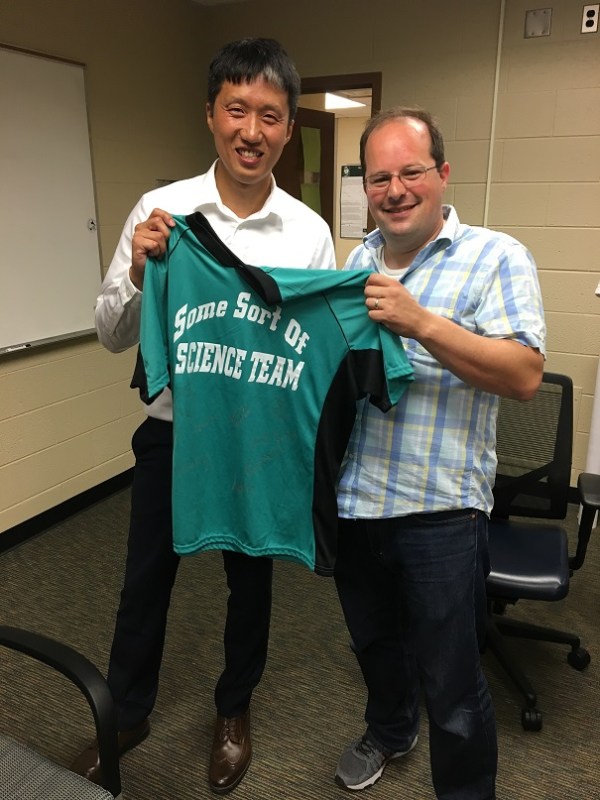
Congratulations to Wei-Tao for successfully defending his dissertation today! Wei-Tao has done excellent work on several projects (silicon defect photophysics, cyanine photochemistry, and time-dependent electronic structure method development). In a couple of months Wei-Tao will join the group of Jochen Blumberger at University College London as a postdoc. We can’t wait to see the great things he will do there and beyond!
Welcome, Katy!
Welcome to new graduate student Katy Humphries! Katy is co-advised by Jim McCusker and will be studying the photochemistry of interesting transition metal complexes.
Farewell, Andrew!
Today was summer REU student Andrew LaDuca’s last day. In a short 10 weeks, Andrew gained useful insights into the electrochemistry of an interesting class of organic molecules with hypothetical applications in water splitting and energy storage. Best wishes for your senior year at Grand Valley and future career!
New Paper on Nonadiabatic Dynamics on Many Electronic States
Check out Dmitry’s new paper in JPCL, describing our new method for modeling nonadiabatic molecular dynamics in dense manifolds of electronic states. In short, it does not require full knowledge of the many electronic PESs involved in the dynamics, but does not suffer from well-known problems arising from the mean-field nature of Ehrenfest dynamics.
New Paper on Defect-Defect Interaction during Recombination
Check out Wei-Tao’s newest paper in JPC C, describing an AIMD study of nanoparticle models containing multiple dangling bond defects. We find that nuclear relaxation effectively uncouples neighboring defects, even at very short range, resulting in recombination dynamics that are nearly identical to those observed in isolated defects.
Perspective on Intersection Locality
Better late than never: Check out our recent perspective article in PCCP, arguing that the lowest energy conical intersections are inherently local feature of molecules. That is, they arise from spatially local distortions of the geometric and electronic structure. This locality has important consequences for photochemistry and photophysics.
Double Congratulations!
Congratulations to Fangchun and Andy for passing their candidacy exams this work. Great work, guys!
Annual Review on Conical Intersections at the Nanoscale
Check out our group’s article in the 2019 Annual Review of Physical Chemistry covering our work on modeling conical intersections in semiconductor nanomaterials.
Nonradiative Recombination in Perovskites
Check out Mike’s new paper in JPCA! In it, we analyze the low propensity for nonradiative recombination in lead halide perovskites by identifying and characterizing conical intersections in two models of the surface of CsPbBr3. We only find conical intersections that are inaccessible upon excitation across the bulk band gap. Analysis of the electronic structure around these intersections suggests that the ionic nature of the material contributes to the high energy of the intersections.
 Levine Research Group at Stony Brook University
You must be logged in to post a comment.